





Short of moving house, the ceiling is the one measurement in a simulator room you can't change. We plan on 2.8m for a full driver swing, and a standard British room sits around 2.4m. Here's what fits under each height, how to test your own room with a slow swing, and what to build when the answer is irons and wedges.
Quick summary
- We plan on 2.8m (9ft 2in) of ceiling for a full driver swing, and 3m (9ft 10in) for every club with headroom to spare.
- An 8ft ceiling is 2.44m, which suits wedges and short irons but is often too low for a comfortable driver swing.
- A 9ft ceiling is 2.74m, 6cm under our 2.8m, so the driver fits some golfers and not others, and a slow swing in the room settles it.
- A 10ft ceiling is 3.05m, which clears every club and suits a ceiling-mounted launch monitor.
- Camera launch monitors on the floor need no ceiling height of their own, while ceiling units need at least 2.59m for the ProTee VX and 2.7m for Trackman iO.
- Every SimBox frame stands 2.5m, 2.8m or 3m tall, so under a 2.4m ceiling you hit into a practice net instead.
What ceiling height do you need for a golf simulator?
About 2.8m, or 9ft 2in, for a full swing with a driver. That's our recommended minimum, and it's the room height we give for a SimBox. 3m, or 9ft 10in, is comfortable, and it's what we'd aim for if you're tall or you swing upright.
Below 2.8m a simulator still works, just not with every club. Wedges and short irons need the least height, and the driver needs the most, because it's the longest club in the bag.
Height is one of 3 numbers. The full room dimensions we plan a SimBox bay around are 3m wide, 2.8m high and 4.5m deep with a camera unit beside the ball, or 5m deep with a radar unit behind you. The launch monitor you choose changes the depth you need, but nothing you buy lowers the height a driver swing needs, which is why we measure it first.
Ceiling heights usually get quoted in feet, so here's what the common ones mean in metres.
| Ceiling | In metres | What it usually allows |
|---|---|---|
| 8ft | 2.44m | Wedges and short irons; often too low for a comfortable driver swing |
| 8ft 6in | 2.59m | Irons, and the lowest height ProTee reports the VX working at |
| 9ft | 2.74m | Most clubs; test the driver with a slow swing first |
| 9ft 2in | 2.79m | Our 2.8m minimum for a full driver swing |
| 9ft 10in | 3.00m | Every club with headroom, and the ProTee VX at its best |
| 10ft | 3.05m | Every club, and Trackman iO's Mid and High versions |
What fits under each ceiling height?
Every 20cm changes what the room can take. The chart draws the 4 common heights to scale, from the 2.4m of a typical British room up to 3m, with what we'd put under each one.

A 2.4m (8ft) ceiling
This is the standard British room height: 7ft 10in, a touch under 8ft. Plan the room around irons and wedges. 2.4m is often too low for a comfortable driver swing, and a slow swing in the room tells you quickly whether yours fits.
It also rules out every SimBox frame, because the shortest one stands 2.5m tall. That leaves a practice net, a hitting mat and a camera launch monitor on the floor beside the ball, with the numbers and the ball flight on a tablet, a laptop or a TV. It's a practice room more than a simulator, which is no hardship when what you're after is your real yardages.

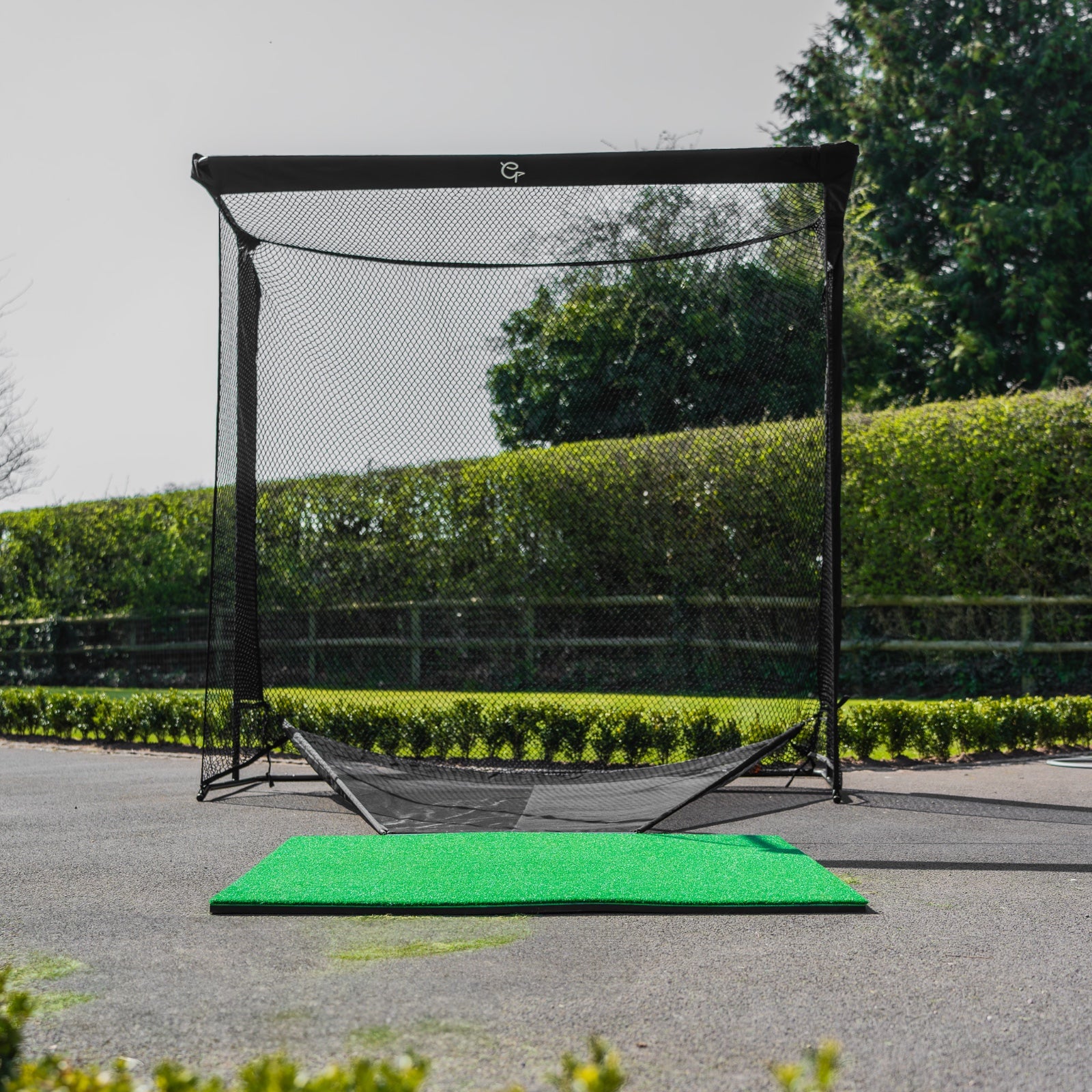
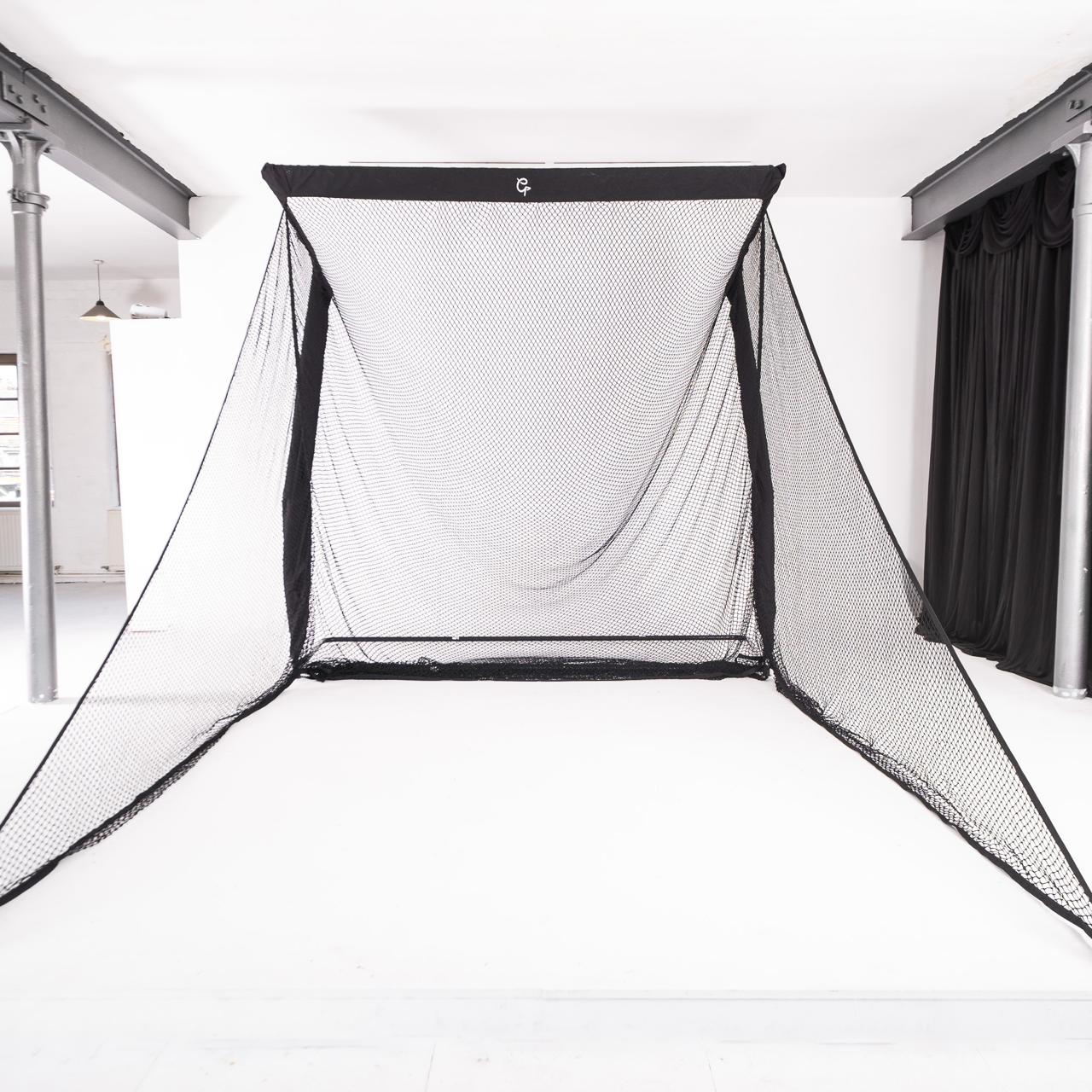
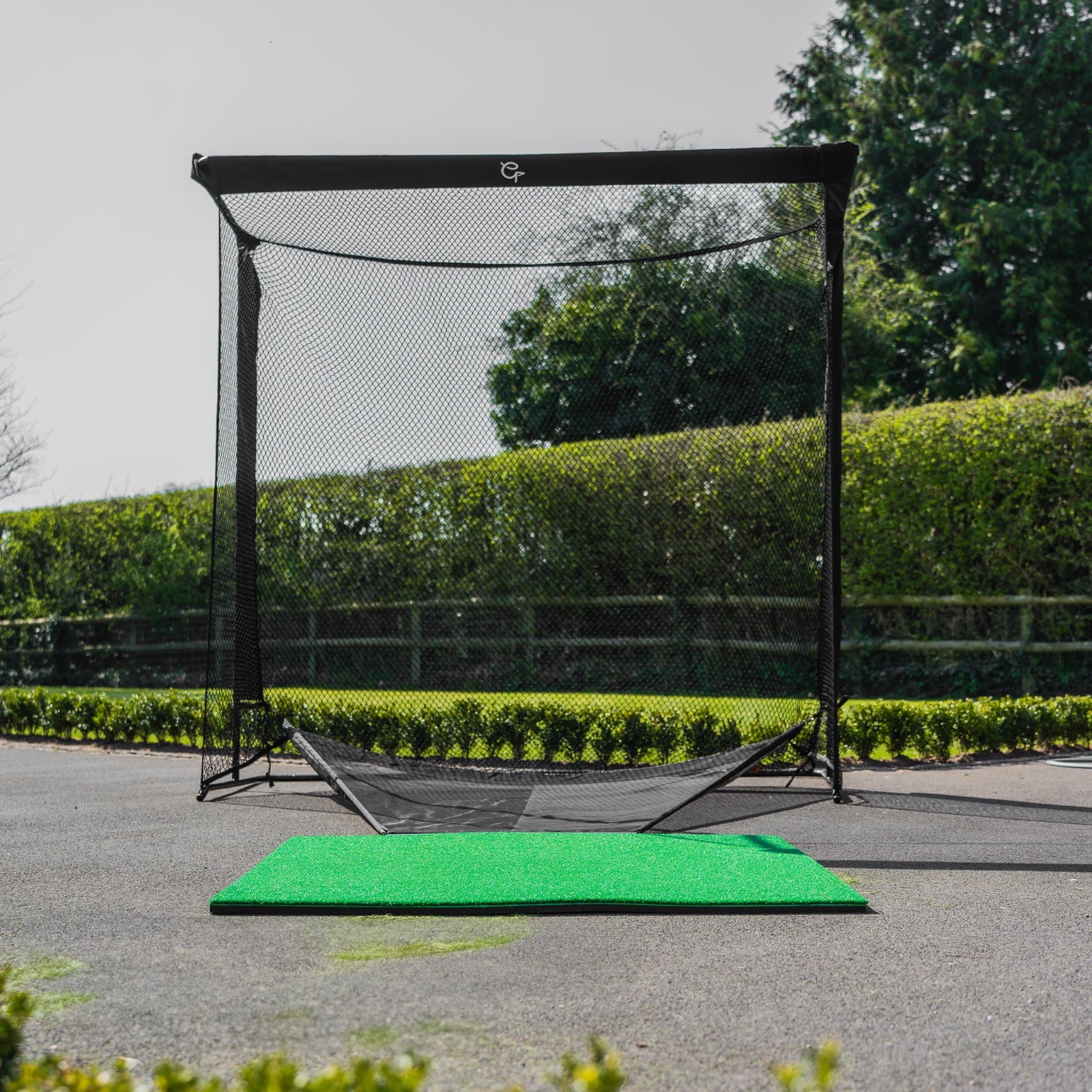
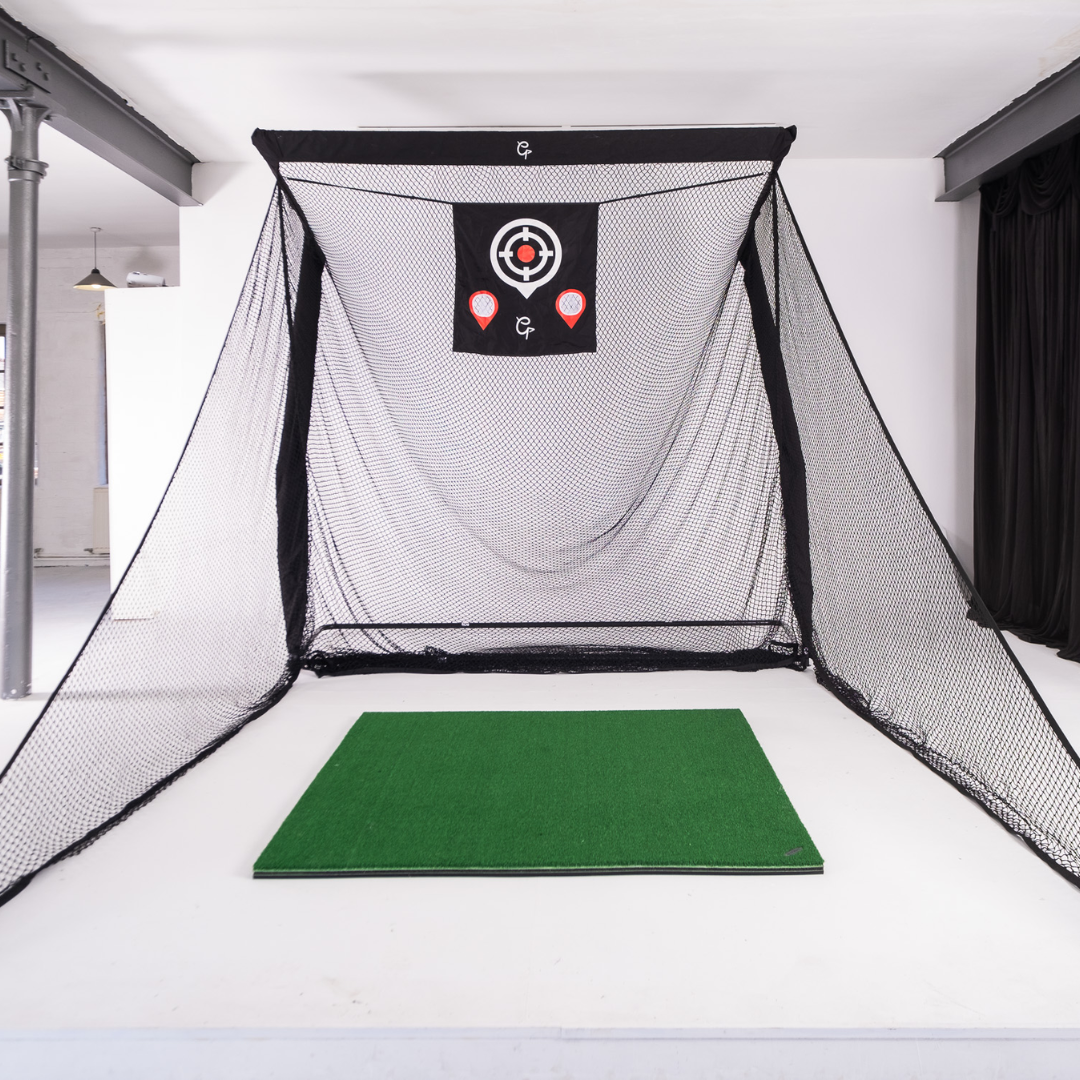
The TrueStrike TS-5 practice net is made for tight spaces. It stands about 2m tall with its roof extension up, so it fits under a 2.4m ceiling with room to spare, and it sends the ball back to you after every shot, for £229. It takes every club in the bag, so the only limit on what you hit is the ceiling above it.
Nothing gets fixed to the ceiling above the swing at this height. The ProTee VX and Trackman iO both need more than 2.4m, and a projector hung over the hitting area sits right where the club goes.
A 2.6m (8ft 6in) ceiling
The 2.5m-high SimBox frames go in at this height, which means a proper enclosure with an impact screen and a projected picture, and you hit from behind the frame rather than under it.
Irons and wedges are still the plan. The driver is a maybe: 2.6m is 20cm under the 2.8m we plan on, so do the slow swing test before you plan the room around it.
2.6m also takes a ceiling-mounted launch monitor: ProTee calls 8ft 6in, or 2.59m, low but workable for the VX.
A 2.8m (9ft 2in) ceiling
This is our recommended minimum for a full driver swing, and the room height we give for a SimBox bay, with the projector allowed for.
If you're tall or you swing upright, add a little headroom on top, and test it with your own driver rather than trusting the tape measure. The tallest golfer in the house, or the mate with the steepest swing, sets the height the room has to clear.
Both ceiling units work here. Trackman iO's Low version covers 2.7m to 2.9m of turf to ceiling, and 2.8m is above every height ProTee lists as low for the VX.
A 3m (9ft 10in) ceiling or higher
3m is where the ceiling stops being the thing you plan around. Every club fits with room to spare, taller golfers included, and there's space to hang a short throw projector in front of the golfer, well clear of the swing.
Ceiling launch monitors are at home here too: the ProTee VX is at its best at 3m, and 3m sits inside both Trackman iO's Mid and High ranges. The 3m-high SimBox sizes need a room taller than 3m to stand in, so in a room that's exactly 3m, the 2.8m-high frame is the tallest that fits.
How do you check if your ceiling is high enough?
With a tape measure and a driver. Do it before you buy anything, because it's the test that decides everything else.
1. Find the lowest point above the hitting area. That's rarely the ceiling itself. Look for lights, beams, joists, pipes, a loft hatch and, in a garage, the door runners and the motor. Measure to the lowest of them, above where you'll stand and where the club will swing.
2. Measure from the top of the mat. A hitting mat, and any base or new flooring under it, lifts you off the floor, and every centimetre it adds comes off the ceiling.
3. Make a slow swing with your driver. Stand where the ball will be, take your normal address in the shoes you'll play in, and swing to the top at walking pace. Anything the club brushes on a slow swing, it will hit on a real one.
4. Swing through to the finish. The club climbs again on the way through, so check the finish as well as the top of the backswing.
5. Repeat it for everyone who'll use the bay. A room that suits you may not suit a taller partner, a teenager who's still growing or the mate who swings straight up.
If the driver clears with a little to spare on a slow swing, the room works. If it brushes, you're choosing between the fixes below and a taller room.
GolfBays tip
Prop a phone up on video at the side of the room while you make the slow swing. The recording shows how close the clubhead gets to the ceiling at the top and at the finish, which is almost impossible to judge while you're the one swinging.
What can you do with a low ceiling?
A low ceiling limits which clubs you hit indoors and where the kit can go, not whether you can have a bay. These are the fixes, from the free ones to a new building at the bottom of the garden.
Irons and wedges indoors
Plan the bay around the clubs that fit. A room that takes a full swing with your wedges and short irons is a proper practice room for the clubs that do most of the scoring.
The launch monitor doesn't care which club you hit. Your carry, launch and spin with a 9-iron are just as real under a 2.4m ceiling as under a 3m one, and the driver can live at the range until the evenings get lighter.
A shorter, flatter swing
Some golfers fit the driver under a low ceiling with a three-quarter backswing or a flatter swing. It's a compromise: the numbers you get are for that swing, not your full one, so treat driver sessions as practice for a controlled shot rather than a measure of your top speed.
A driver cut down for indoor use lowers the arc as well, but it's a different club, so its numbers won't match the driver in your bag.
A camera launch monitor on the floor
A camera unit sits on the floor beside the ball, reads it at impact, and needs nothing from the ceiling and no room behind you. If you can swing in the room, a camera unit can read the shot, and there's nothing overhead for the club to find.
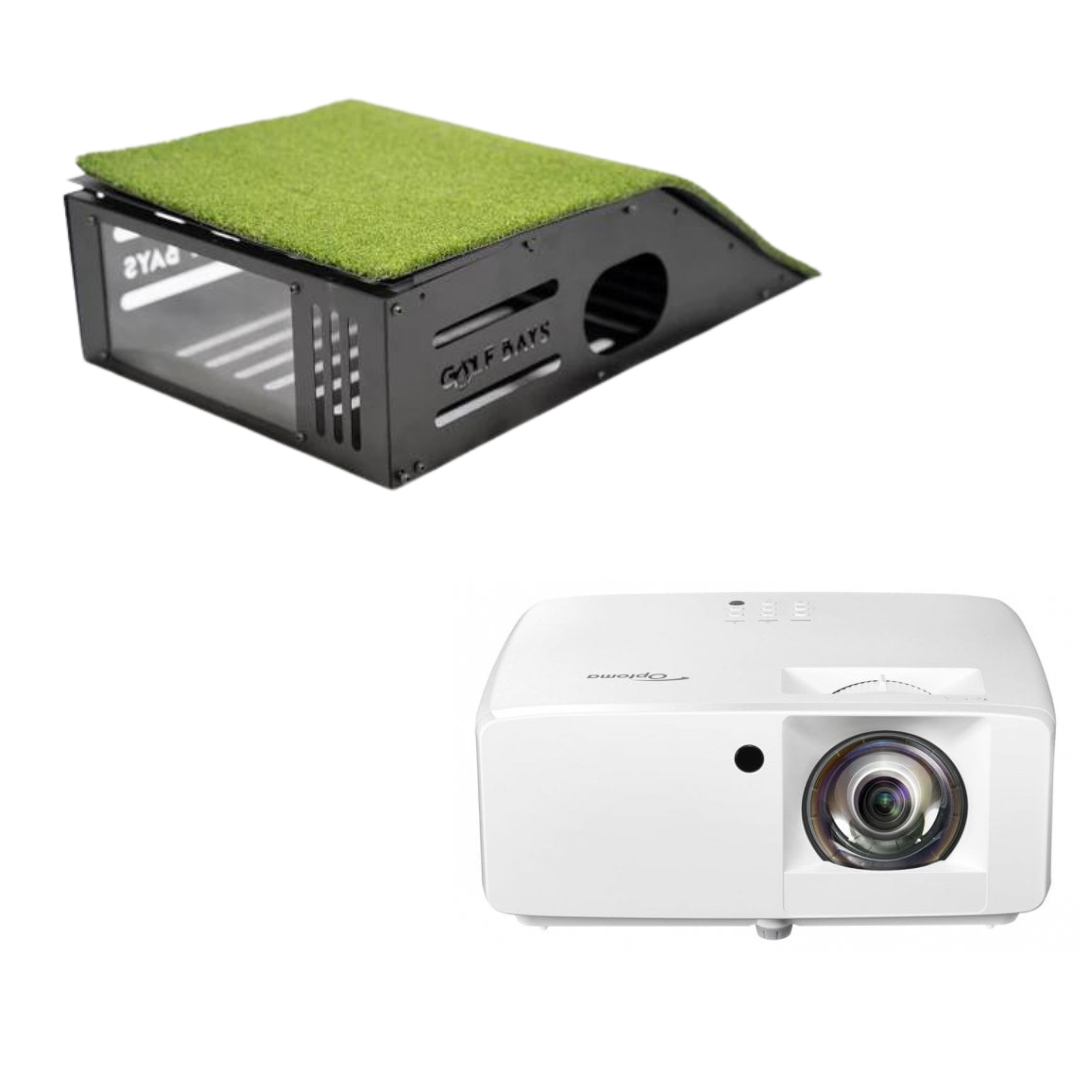
A projector on the floor
A ceiling-mounted projector in a low room hangs close to the swing. Put it on the floor instead, where the club can't reach it.

Our floor mounted projector case is a steel box with a turf-covered ramp on top. It sits beside or in front of the tee area, low shots run up the turf towards the screen, and it takes most short throw projectors, for £159.99.
✓ Do this
Put the launch monitor on the floor beside the ball and the projector in a floor case, so nothing hangs into the swing.
✕ Not this
Fix a projector or a ceiling launch monitor above the hitting area of a 2.4m room and hope the club always misses it.
Lights and fittings out of the swing
Pendant lights, a bare bulb on a flex and a loft hatch that opens downwards all take height out of the room. Swap them for flush fittings or move them away from the hitting area, and the room's real height goes back to the ceiling itself.
If the club might still touch, a layer of foam over the ceiling above the hitting area protects the plaster, and the club.
A garden cabin built to height
When no room in the house is tall enough, build one that is. A garden room built to the height a driver needs gets you the ceiling a house can't, with the simulator set up for good and the noise at the bottom of the garden rather than through the lounge ceiling. Our golf simulator cabins start at £13,299.
In England most golf simulator cabins can go up under permitted development if they meet the outbuilding rules, and height is the rule to check: 2.5m at the eaves, 4m overall with a dual-pitched roof or 3m with any other, and 2.5m overall within 2m of a boundary (Planning Portal).
Not sure your ceiling's high enough?
Send us your room's height, width and depth, and we'll tell you which clubs will fit, which launch monitor suits it and which SimBox size to buy. It's free.
Book a free consultationWhich launch monitors need ceiling height?
Only the ones that mount on the ceiling. Camera and ceiling-mounted launch monitors sit at opposite ends of the question: a camera unit on the floor needs nothing from the ceiling, and a ceiling unit needs the ceiling within a set range.
| Launch monitor | Where it sits | Ceiling it needs | Price |
|---|---|---|---|
| Square Golf | On the floor, beside the ball | None of its own | £689 |
| SkyTrak ST MAX | On the floor, beside the ball | None of its own | £1,695 |
| ProTee VX | On the ceiling | From 2.59m, best at 3m | £6,240 |
| Trackman iO Home | On the ceiling | 2.7m to 3.2m, by version | £12,594 |
Ceiling heights are measured from the hitting surface to the ceiling, as each maker specifies.
Camera units beside the ball
For a low ceiling, this is the type to buy. The cameras sit in a unit on the floor across the ball from you and read the ball, and on some models the club, at the moment of impact.

Under a low ceiling, the SkyTrak ST MAX is the unit we'd reach for first. It reads the shot from the floor beside the ball, so nothing hangs overhead and nothing stands behind you, and it's £1,695 with a year of SkyTrak Core, which plays more than 30 courses. The catch: once that first year is up, the courses need a paid SkyTrak membership.

The Square Golf launch monitor does the same job from the floor for £689. Its cameras take in the clubhead as well as the ball, so you see how you delivered the club as well as where the ball went, and there's a putting mode for the end of the session. The catch: it sits across the ball from the golfer, so it changes sides whenever a left-hander steps in.
Radar units behind the ball
Radar units don't need the ceiling either, but they need depth. They sit on the floor behind you and watch the ball fly, so we plan on 5m of room depth for one. In a room that's low and short, a camera unit is the better buy. Radar comes into its own in a deep garage, or out in the garden with no ceiling at all and all the room it wants behind the ball.
Ceiling-mounted units
A ceiling unit looks down on the hitting area, so there's nothing on the floor to trip over or catch with the club. The price of that is height: each one works within a range of ceiling heights, and its maker sets the range.

Trackman iO Home is £12,594 and works entirely from above the mat, pairing radar with infrared and high-speed imaging, and the spin and spin axis it reports are measured in 3D. Trackman makes it in 3 versions for different ceilings, each measured from the turf to the ceiling: Low for 2.7m to 2.9m, Mid for 2.85m to 3.05m and High for 3m to 3.2m (Trackman).
The catch: nothing goes below 2.7m, so a 2.6m room is out whichever version you choose.

The ProTee VX costs £6,240, about half the Trackman figure, and GSPro comes with it in our bundle. Its 2 high-speed cameras watch from overhead, and it reads the balls you already play, with no stickers. ProTee puts its best height at 3m from the hitting surface to the ceiling. In its own tests 8ft 6in, or 2.59m, was low but workable, with a ball like the TP5 for correct spin on high-speed shots, while 8ft 4in, or 2.54m, was too low, partly because a wedge on the way up could hit the unit (ProTee).
The catch: in a room under 2.8m the VX works but your driver may not, so do the slow swing before you drill the ceiling.
With the VX on the ceiling, golf simulator room layouts that a floor unit makes awkward open up, with the mat in the middle of the bay and nothing to move for a left-hander. We also stock overhead units from Uneekor, Foresight and NVISAGE, and each has its own mounting height, so check the maker's figure against your ceiling before you order.
GolfBays tip
Fit a ceiling unit last. It's mounted in relation to where the ball sits, so settle the mat, the enclosure and the hitting position first. Moving the mat after the mount goes up means moving the mount, and filling holes in the ceiling.
How tall is a golf simulator enclosure?
Our SimBox frames stand 2.5m, 2.8m or 3m tall, depending on the size. Most are 2.5m, the 3.8m-wide size is 2.8m, and the 2 deepest sizes are 3m tall.

The SimBox enclosure is an aluminium frame that goes up without tools, in 7 sizes, with a LITE, a PRO+ or, on most sizes, a Close-Knit Baffle impact screen. Custom sizes are available on request.
| Width | Height | Depth | Price with LITE screen |
|---|---|---|---|
| 2.6m | 2.5m | 1.5m | £1,161 |
| 3m | 2.5m | 1.5m | £1,214 |
| 3.6m | 2.5m | 1.5m | £1,259 |
| 4m | 2.5m | 1.5m | £1,304 |
| 3.8m | 2.8m | 1.5m | £1,358 |
| 3m | 3m | 3m | £1,439 |
| 4m | 3m | 3m | £1,529 |
The frame's height and the room's height are 2 different numbers. On the 1.5m-deep sizes you hit from behind the frame, at least 2.5m from the screen, so the frame only has to stand under the ceiling while your swing needs the full 2.8m. Even around a 2.5m frame, the room needs 2.8m for a full driver swing and the projector.
A 2.5m frame in a 2.6m garage still gives you the screen, the surround and the projected picture, and the ceiling decides which clubs you hit in front of it.
Which rooms have the height for a golf simulator?
The garage
A garage usually has more height than a spare room, but the joists, lights and door gear hang lower than the ceiling itself. A garage with a 2.4m ceiling is an irons and wedges room like any other, so measure the lowest point above the hitting area, not the highest point of the roof.
The garage still wins on almost everything else: more width and depth than most spare rooms, a concrete base for the mat and no living space given up. If the height is borderline, a camera unit and a floor projector case get the most out of it.
Watch out: the garage door
An up-and-over door swings up into the garage and hangs below the ceiling when it's open, and a roller door keeps its drum and motor at the top of the opening. If the door has to open while you play, measure the height under the door gear, not under the ceiling.
The spare room
A spare room comes heated, dry and full of sockets, but a standard British room sits around 2.4m high. That's often too low for a comfortable driver swing, so plan it as an irons and wedges room: a net, a mat and a camera unit, with a TV or a tablet for the ball flight.
Think about who's on the other side of the floor and the walls, too. Strikes on the mat carry to the room below, and in a semi the neighbours can hear them through the party wall.
The loft
A loft conversion can have plenty of height in the middle and very little at the sides. Measure under the spot where you'd stand, and remember that the club travels behind you and over your shoulder, so the slope has to clear the club all the way round, not just the top of your head.
Carry the kit up the stairs in your head before you order it, too. A SimBox arrives in parts and clicks together in the room, which suits a loft better than anything that arrives in one piece.
A garden room you already have
An existing garden room, summer house or home office at the bottom of the garden looks tall from outside and often isn't inside. Roof structure, insulation and floor build-up can take 20cm to 30cm of height between them, so measure inside, from the floor you'll stand on to the lowest point of the ceiling.
If it comes up short, treat it like any other low room: irons and wedges, a camera unit on the floor and nothing hanging above the swing.
Golf simulator ceiling height FAQs
What happens if my ceiling is too low for a golf simulator?
The club hits the ceiling, usually at the top of the backswing or in the follow-through, which can damage the club, the ceiling and anything fixed to it. If the room's too low for a full swing, hit irons and wedges indoors, use a camera unit on the floor and keep anything mounted off the ceiling above the hitting area.
Is an 8ft ceiling enough for a golf simulator?
It's enough for wedges and short irons, but often too low for a comfortable driver swing. 8ft is 2.44m, 36cm under the 2.8m we plan on for a full driver swing, so an 8ft room suits a net, a mat and a camera launch monitor on the floor.
Is a 9ft ceiling tall enough for a golf simulator?
Nearly. 9ft is 2.74m, 6cm under our 2.8m minimum, so most clubs fit and the driver fits some golfers. It's also tall enough for Trackman iO's Low version and the ProTee VX.
Can you swing a driver with a 9ft ceiling?
Some golfers can and some can't. At 2.74m you're just under the height we plan on, so a golfer with a flatter swing may clear it and a tall golfer with an upright swing probably won't. Make a slow swing with your driver in the room before you decide.
Is 10ft high enough for a golf simulator?
Yes. 10ft is 3.05m, above the 3m we'd call comfortable, so every club fits with headroom. It's within 5cm of ProTee's best height for the VX, and it sits inside Trackman iO's Mid and High ranges.
What is the minimum ceiling height for a golf simulator?
2.8m for a full driver swing, which is our recommended minimum. A simulator works lower down for irons and wedges, but no SimBox frame stands under 2.5m, and neither ceiling unit here goes below 2.59m on its maker's figures.
Can you put a golf simulator in a room with a low ceiling?
Yes, if you build it for the clubs that fit. A 2.4m room takes a practice net, a mat and a camera launch monitor on the floor, and a 2.6m room takes a 2.5m-high SimBox with a projector in a floor case.
Can you use a ceiling-mounted launch monitor with a low ceiling?
Only down to its maker's lowest height: 2.59m for the ProTee VX and 2.7m for Trackman iO, measured from the hitting surface. Below that, put a camera unit on the floor beside the ball instead.
What should go on the ceiling above a golf simulator?
As little as possible above the hitting area. Use flush lights rather than pendants, hang a projector only where the ceiling is high enough to keep it clear of the swing, and mount a ceiling launch monitor only within its maker's height range. In a low room, keep all of it off the ceiling above the swing.
Find a bay that fits your ceiling
SimBox frames come in 2.5m, 2.8m and 3m heights and 7 sizes, from a single garage to a dedicated golf room.
See golf simulator enclosures